Art & Architecture
article | Reading time3 min
Art & Architecture
article | Reading time3 min
Discover the art of society portraiture through Winterhalter’s prestigious studio.
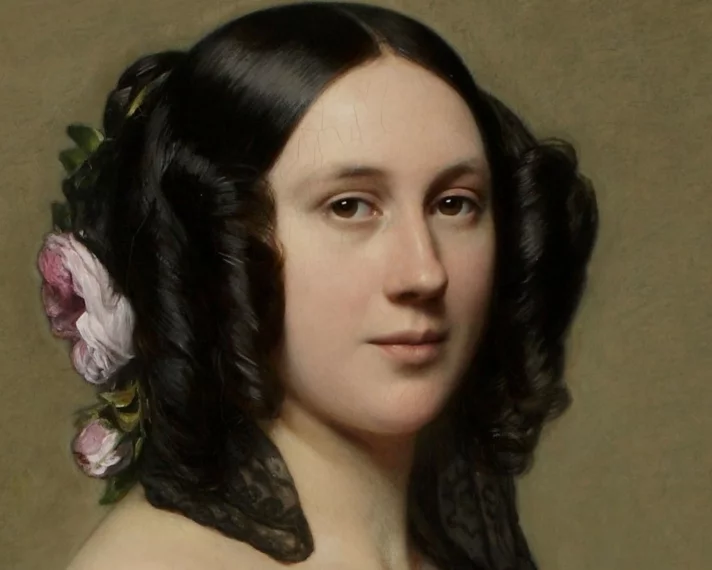
© Centre des Monuments Nationaux/David Bordes.
Hermann Winterhalter was the younger brother of the famous court portraitist of Baden, Franz Xaver Winterhalter. In 1837, he joined his elder brother in Paris, where he settled in order to fulfil the numerous commissions his brother was receiving. Hermann Winterhalter also painted portraits in his own right, drawing inspiration from his brother, who painted the crowned heads of Europe. The two brothers were so similar in their work, artistic vision and personality that it is difficult to distinguish between some of their works.
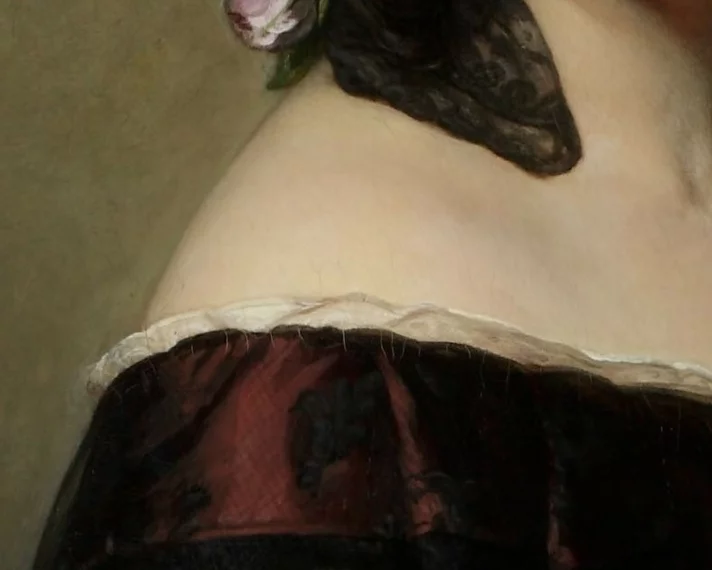
Louise Rouen des Mallets, Viscountess Terray de Morel-Vindé, was the daughter of the Prefect of Vaucluse, Alexandre Jean Denis Rouen des Mallets (1779–1871), prefect of Vaucluse; in 1839, she married Charles Terray de Morel-Vindé (1802–1866), Viscount Terray de Morel-Vindé, a counsellor at the Court of Paris. At the very end of the July Monarchy, the young woman adopted a modest style, yet the sophistication of her hairstyle attracted attention. She wears ample curls on either side of her face , which had been known as ‘anglaises’ since 1829 and remained in fashion throughout the 1850s. Roses are arranged at the back of her hairstyle, thus justifying the three-quarter view of her face. Wearing a summer dress with a low neckline, she casually holds a fan whilst letting a shawl of fine black lace slip over her white arm.
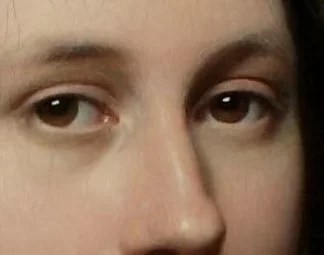
The painter’s idealised style is perfectly suited to the art of society portraiture, particularly in the smooth rendering of the skin, softened by the light. A subtle mastery of light and shadow serves to emphasise the oval shape of the face, whilst a precise beam of light bounces off the young woman’s right shoulder, extending down to her décolletage, lending the portrait a faintly erotic tone. The neutral background, however, features two cast shadows: that of the model and, perhaps, that of the painter.
© Centre des Monuments Nationaux/David Bordes.
© Centre des Monuments Nationaux/David Bordes.
© Centre des Monuments Nationaux/David Bordes.
Hubert Mayer, The Winterhalter Family of Artists: A Correspondence, Braun, Karlsruhe, 1998.
Richard Ormond, Carol Blackett-Ord, *Franz Xaver Winterhalter and the Courts of Europe, 1830–70*, exhibition catalogue, National Portrait Gallery, London, 1987.
Heritage Curator