Art & Architecture
article | Reading time4 min
Art & Architecture
article | Reading time4 min
Discover Van Dyck’s innovative iconography.
© Alain Lonchampt/Centre des Monuments Nationaux.
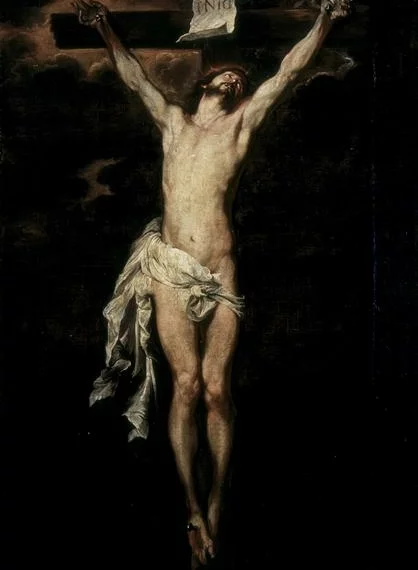
This famous depiction of Christ on the Cross by Antoon van Dyck, painted whilst he was living in Italy, probably dates from the 1630s, a period during which he produced his finest altarpieces. In his ‘Christ on the Cross’, the Venetian influence is evident in the vibrant, golden light surrounding Christ’s body.
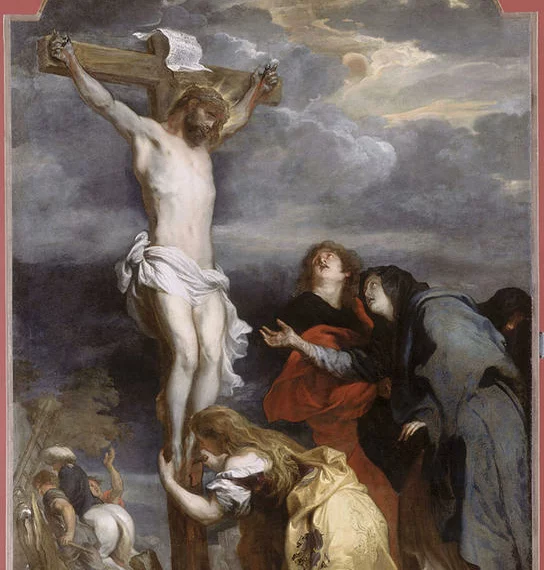
The painting’s success lies in its innovative iconography, which is both dramatic and elegiac, and which immediately inspired many painters associated with the Flemish master’s circle. The most striking iconographic element is the centrality, as well as the isolation, of the figure of Christ within the composition. Unlike the Crucifixion housed in Lille, van Dyck depicts no figures around Christ, whereas the scene is usually completed by the presence of Mary, Mary Magdalene, John, the thieves or soldiers…
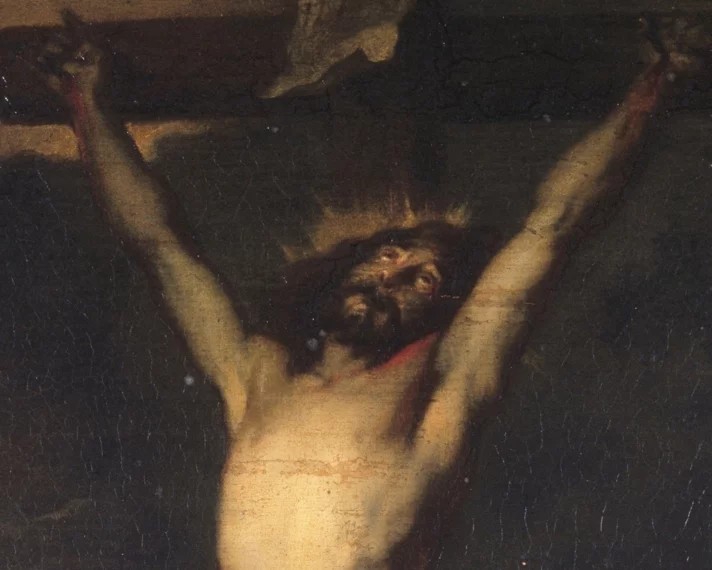
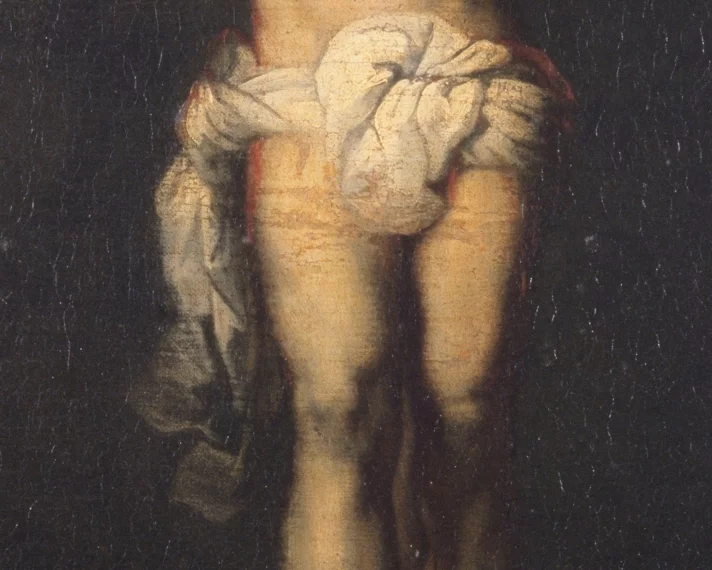
Here, Christ is alone, and the sense of drama is accentuated by a sombre colour palette, which contrasts with Christ’s golden body, whose face expresses serene surrender to the divine light. The cloth draped around his hips, supple and flowing, echoes the undulating form of the body’s muscles, whose contours are emphasised by a blood-red line.
The work’s inspiration is rooted in the broader context of the Counter-Reformation, a movement through which the Catholic Church responded to the Protestant Reformation during the 16th century, notably by encouraging the development of vivid depictions ofGospel scenes within churches, with the aim of stimulating Catholic fervour. Whilst the early Christians avoided depicting Christ on the cross, the figure of the ‘Triumphant Christ’ ’ (Christus triumphans) that was favoured in the Middle Ages, whilst the ‘dead Christ’ ’ (Christus patiens, the resigned Christ) developed in the Byzantine painting. It was the Italian Primitives who pioneered depictions of a humanised Christ suffering martyrdom (Christus dolens), a central theme of the Counter-Reformation which encouraged the creation of more poignant representations, as seen in van Dyck’s painting.
The painting enjoyed great success from the17th century onwards and was widely copied, either faithfully or with variations. The original work is held at the Kunsthistorisches Museum in Vienna. The best-known versions are those in the Palazzo Reale in Genoa and the Museo di Capodimonte in Naples. Aulteribe’s version is smaller in scale than the one in Vienna, considerably darker, and with less refined modelling, both in the figure of Christ himself and in the drapery. This copy probably dates fromthe 19th century.
© KHM Museums Association
© Lille Museum of Fine Arts.
© Wikipedia
© Alain Lonchampt/Centre des Monuments Nationaux.
© Alain Lonchampt/Centre des Monuments Nationaux.
Heritage Curator