Art & Architecture
article | Reading time4 min
Art & Architecture
article | Reading time4 min
Discover the significance of floral ornamentation in devotional paintings...
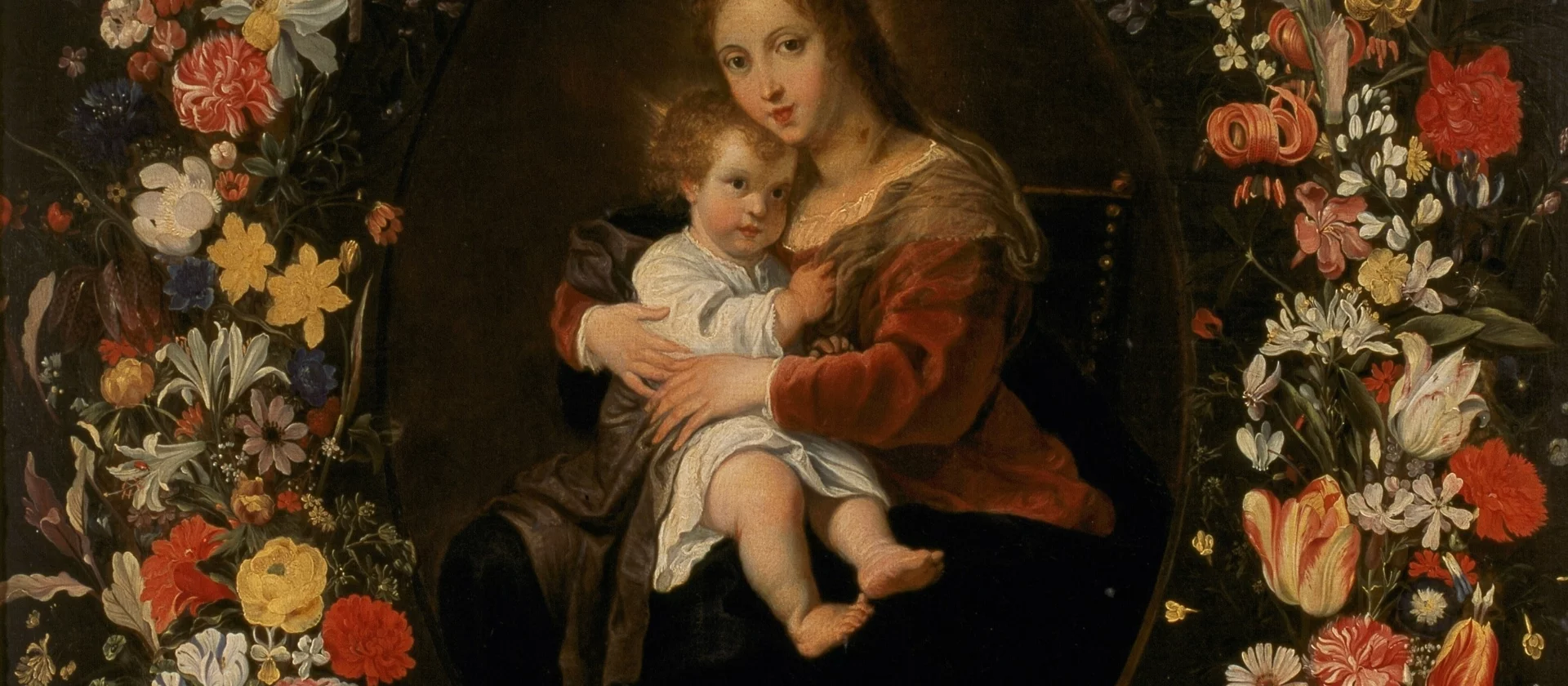
© Centre des Monuments Nationaux/David Bordes
In the16th century, the use of flowers to decorate devotional paintings coincided with the development of botanical gardens and the spread of rare and new plants. This ornamentation began with garlands created by specialists who worked alongside portrait painters. Protestant countries particularly excelled in this art form, which was as documentary as it was symbolic, known as floral painting.
The flowers depicted had to be studied throughout the year using living specimens, whether in the ground or in pots (Pierre Valet), and then arranged into a coherent composition free from seasonal constraints. Each was chosen for its specific meaning.
In religious subjects, the Marian devotion favoured certain flowers, such as the rose or the lily. The carnation, whose scientific name Dianthus means ‘Flower of God’, thus naturally accompanied certain depictions of the Virgin and Child.
The name of Jan Brueghel (1568–1625), known as ‘Brueghel the Velvet’, was immediately identified as the artist responsible, as it was the painter who created an original style of oval garlands and festoons of flowers and fruit set against a dark background. The central medallion is usually painted by one of his contemporaries (Rubens, van Balen or even, on occasion, an Italian artist). This is the case with the painting held at the Louvre, whose central medallion is now attributed to Pierre Paul Rubens (1577–1640).
According to Jacques Foucart, the delicate, realistic treatment of the wreath of flowers suggests that the work should be attributed to Jan I Brueghel. It is strikingly precise in its naturalistic detail: roses, lilies, variegated tulips, carnations and forget-me-nots are further brought to life by a wide variety of insects. Klaus Ertz and Christa Nitze-Ertz devote a note to the Aulteribe painting, no. 467, in ‘Jan Brueghel the Elder (1568–1625)’, Lingen, 2008–2010, they devote an entry to the Aulteribe painting (no. 467): they confirm Jacques Foucart’s attribution (1977) and believe that the painting was completed by his son, Jan Brueghel the Younger. Seventy paintings of wreaths of flowers by Jan Brueghel are known to exist. The elder Brueghel left many of these paintings unfinished upon his untimely death in 1625, and it was his son who completed them. The father commissioned renowned Antwerp masters to paint the small religious scene in the centre, such as Rubens, H. van Balen or F. Francken the Younger… The son, on the other hand, entrusted the central space of the composition to much less well-known painters, which creates, as in the case of the Aulteribe painting, strange situations where the flowers are of far better quality than the Virgin and Child!
As the INHA entry shows, the Virgin is a reference to a work by Bartolomeo Cavarozzi (c. 1590–1625), painted around 1617 and widely copied in the17th century (see the exhibition catalogue *Bartolomeo Cavarozzi a Genova* in Genoa, Galleria Nazionale di Palazzo Spinola, from 6 December 2017 to 8 April 2018). However, according to David Mandrella, Cavarozzi is here imitating a Rubens-style Madonna, which explains the resemblance. The Ertz family agree with Jacques Foucart that the artist who painted the medallion worked in the manner of Cornelis Schut (1597–1655).
© bpk, Berlin, dist. rmn-grand palais / Jörg P. Anders
© Wikipedia
© RMN-Grand Palais (Louvre Museum) / Stéphane Maréchalle
© Centre des Monuments Nationaux/David Bordes
© Centre des Monuments Nationaux/David Bordes
© Centre des Monuments Nationaux/David Bordes
Breughel-Brueghel: A Family of Flemish Painters around 1600, exhibition catalogue, 1998, Antwerp, Essen, Vienna and Cremona, no. 62.
Jacques Foucart and Jean Lacambre, The Age of Rubens, Grand Palais, 1977–1978, no. 19.
Klaus Ertz and Christa Nitze-Ertz, Jan Brueghel the Elder (1568–1625). Critical Catalogue of Paintings, Lingen, 2008–2010, no. 467.
Gianluca Zanelli, Bartolomeo Cavarozzi in Genoa. Galleria Nazionale di Palazzo Spinola. Genoa, December 2017 – April 2018, Genoa, Sagep, 2017.
Heritage Curator