Art & Architecture
article | Reading time4 min
Art & Architecture
article | Reading time4 min
Discover the scholarly sources and the distinctive features of this Holy Family.
©Hervé Lewandowski / CMN
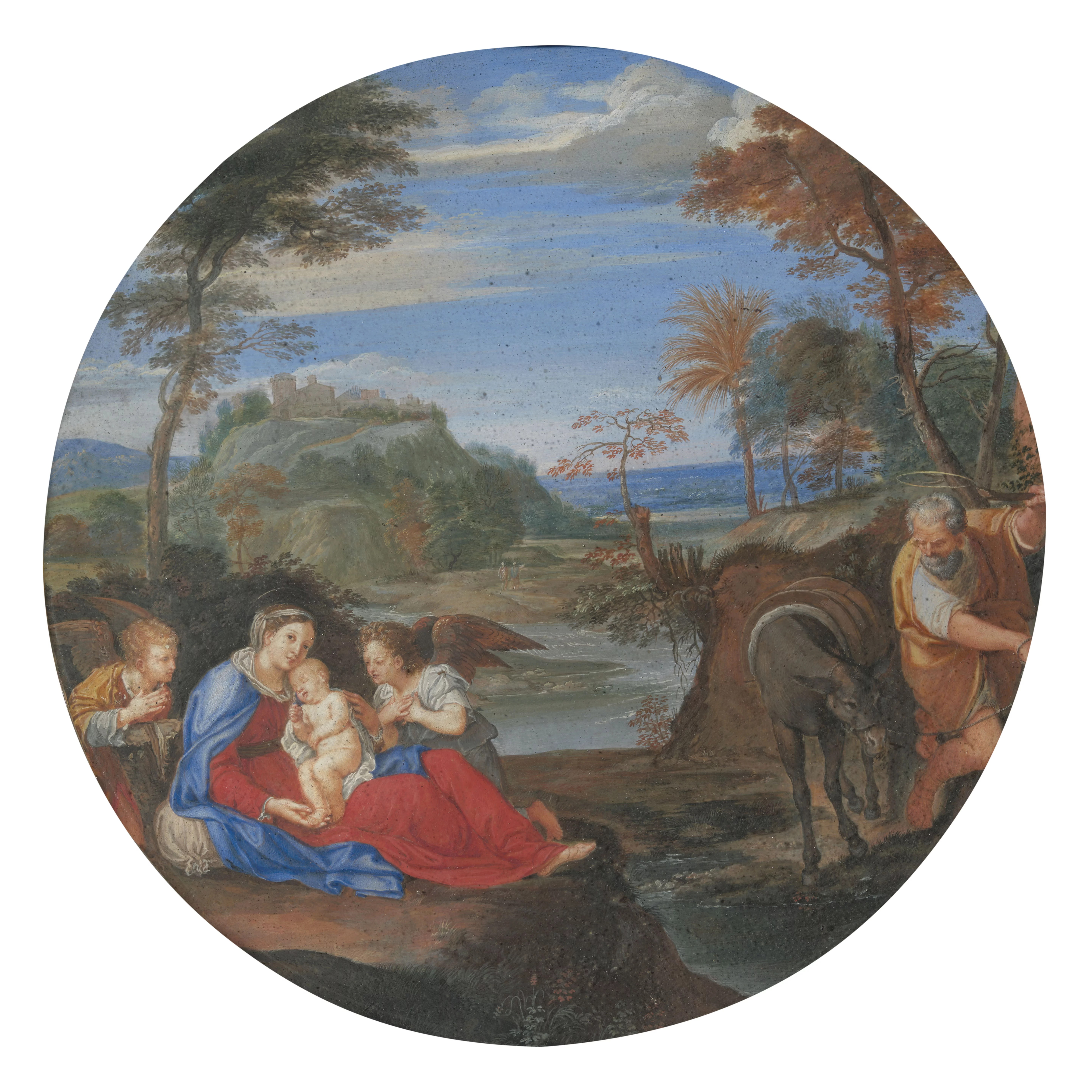
Despite the tenets of the Catholic Reformation, which call for a more authentic depiction of the life of Christ, for many artists the depiction of the Flight into Egypt is merely a pretext, an opportunity to portray a pleasant family scene in a bucolic landscape, without a very clear theological perspective.
The Gospel according to Matthew (Mt 2:13–23), which is the source of the account of the Flight into Egypt, briefly mentions the episode—also known as the Miracle of the Palm Tree—which is described in greater detail in an apocryphal gospel. Mary, weary from the scorching desert sun, spots a palm tree and wishes to rest in its shade. Sitting down, Mary looks up at the top of the palm tree, laden with fruit, and asks Joseph to taste some. Joseph is astonished: ‘You see how high up the dates are, and yet you propose to eat their fruit!’ The infant Jesus, who was resting peacefully in his mother’s arms, then says to the palm tree: ‘Bend down, tree, and feed my mother with your fruit! ’ Obeying these words, the palm tree immediately bends its crown down to Mary’s feet, so that the fruit may be plucked.
The presence of a palm tree in this *Rest on the Flight into Egypt*, held at the Château d’Aulteribe, a copperplate engraving based on the painting by the Italian artist Annibale Carracci (1560–1609), is thus highly faithful to the text, far beyond the simple family and bucolic scene. The work housed in the Hermitage Museum in Saint Petersburg has enjoyed great success. It was copied by Caracci’s followers and marks the birth of the classical landscape, with a rigorously constructed composition that seeks to evoke Virgil’s Arcadia. There is a rectangular version on a wooden panel painted by Francesco Albani, known as l’Albane, a pupil of Carracci, housed at the Princeton University Museum. Apart from its format, this version differs from the original in the absence of one of the angels accompanying the Virgin; the hill and the castle atop it have also been omitted, whilst two putti have been added to the top-left corner. In this respect, Aulteribe’s version is much closer to Carracci’s work, differing from it only in a very slightly tighter framing.
© Wikipedia
© Hervé Lewandowski / CMN
© Hervé Lewandowski / CMN
Heritage Curator