Art & Architecture
article | Reading time4 min
Art & Architecture
article | Reading time4 min
Discover a queen depicted before her husband’s death, as she is dressed in white mourning.
© Pascal Lemaître / Centre des Monuments Nationaux
Iconographic depictions of Louise de Lorraine-Vaudémont remain scarce, whether in the form of full-length ceremonial portraits or busts. It is no doubt for this reason that portraits of the sovereign were still being painted in the17th century. The original from which this copy was made therefore remains to be identified.
The daughter of the Count of Vaudémont, Queen Louise belonged to the Ducal House of Lorraine, a rank which did not predispose her to becoming Queen of France. She was, however, chosen by the young King Henry III, who found her ‘to his taste’, thus entering into a marriage devoid of political motives.
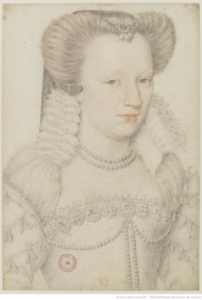
The pose is stiff, as is customary in ceremonial portraits, a stiffness accentuated by the adoption of the so-called ‘Spanish’ fashion, which favoured straight lines. The boned bodice elongates the figure, constricting the bust, whilst the vertugadin—a stiff, bell-shaped petticoat—gives the silhouette the overall appearance of a cone. The costume is adorned here with a sumptuous pearl necklace, which evokes rosaries, although no crucifix hangs from it.
The appearance seems understated, but it is in fact very opulent due to its fabric, embossed in relief in the Renaissance style, despite the sumptuary laws of Henry II (1547) and Henry III. It is true that these sumptuary laws did not apply to the queen and her court, which is why the portrait of Louise de Lorraine features numerous luxurious sartorial details.
The queen’s high hairstyle is typical of the 1580s and 1590s, as is the ruff, the circumference of which decreased slightly during this period – it had previously been as wide as 40 cm – but was adorned with ‘needlework’ lace at its edge, as is the case in this portrait. This fashion was rivalled by that of the fan-shaped ruff seen in her other portraits, as it was Louise of Lorraine who made it fashionable at the Valois court. This fashion endured right up to the time of Marie de Médicis, as shown in her portrait painted in 1603 by Charles Martin, now in the Château de Blois. In all these ceremonial portraits, the pearl is worn in the ear, and the necklace extends well down the dress.
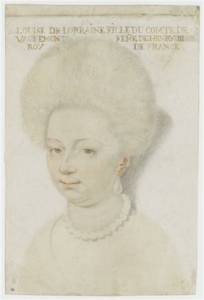
One might think that the portrait was painted after her husband’s death in 1589, but this is not the case, since Louise de Lorraine-Vaudémont observed mourning in white, as was customary at the French court, despite the ‘Italian-style mourning’ in black worn by Catherine de’ Medici on the death of Henry II (1559).
The drawing attributed to the school of Daniel Dumonstier, held at the Louvre, confirms the identity of the sitter, despite her facial features appearing noticeably different in two other portraits: the one held at the Museum of Fine Arts in Houston, dated to the 1570s, and the one by Jean Decourt, ‘ ’, held at the Bibliothèque nationale de France. The hair colour differs particularly markedly, but it should not be forgotten that blonde hair had been in vogue since the time of Catherine de’ Medici. There were numerous ways to lighten hair, such as coating it with a bleaching mixture of saffron and lemon. The drawing in the Louvre thus depicts Louise of Lorraine as a blonde. The mystery therefore remains as to the model used for the copy of this ceremonial portrait.
© BNF
© RMN-Grand Palais (Louvre Museum) / Thierry Le Mage
© Pascal Lemaître / Centre des Monuments Nationaux
© Pascal Lemaître / Centre des Monuments Nationaux
Heritage Curator